


Why Do We Need Bioenergy?
In recent years, the world has been facing a series of energy and environmental challenges:
- Supply-demand imbalance: Crude oil extraction struggles to meet demand, leading to continuously rising oil prices.
- Rising costs: Fossil fuels are finite resources, resulting in increasing power generation costs.
- Geopolitical instability: Frequent geopolitical conflicts have caused volatility in energy import and export prices.
- Extreme climate: Excessive carbon dioxide emissions have increased greenhouse gas concentrations, leading to extreme climate events.
As a result, countries have recognized that, under current consumption rates, traditional energy sources will be rapidly depleted. Developing stable and sustainable alternative energy has become an urgent priority. Bioenergy is considered a key solution to this challenge, as it simultaneously addresses energy shortages, rising costs, and environmental burdens.
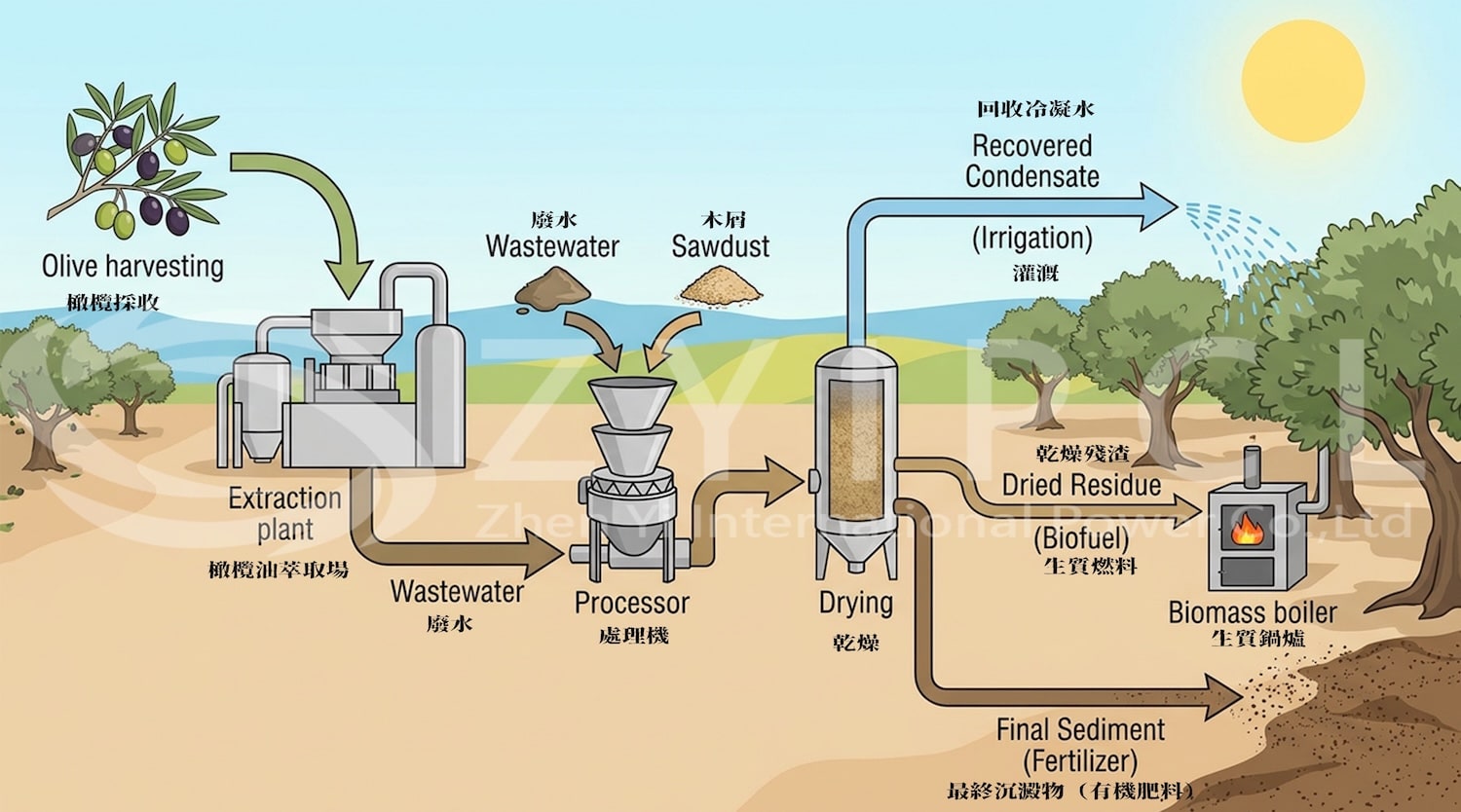
Core Value: Organic Resources for a Circular and Sustainable Future
Fossil fuels will eventually be exhausted, whereas bioenergy utilizes organic waste as feedstock, enabling a circular and sustainable system.
Taking the Mediterranean olive industry as an example, wastewater and wood residues generated during oil production can be mixed and dried. Recovered condensate can be reused for irrigation, dried residues can be converted into biomass fuel, and final sediments can be used as fertilizer—forming a fully closed-loop resource cycle that supports sustainable development.
Local Advantage: Self-Sufficiency and Cost Reduction
Bioenergy emphasizes local production and local utilization, effectively reducing energy import and export costs.
For example, in Taiwan, miscanthus is highly resilient to cold, heavy metals, and salinity. It can be used as a biomass feedstock while also contributing to soil remediation. It is a perennial crop that can be harvested continuously without depletion, making it an ideal locally sustainable resource.
Environmental Protection: Low-Carbon to Near Carbon Neutral
In terms of carbon reduction and environmental protection, bioenergy offers low-carbon or near carbon-neutral characteristics.
For example, wood pellets are produced from biomass that absorbs carbon dioxide during plant growth. The emissions released during combustion are significantly lower than the amount previously absorbed, helping to mitigate the greenhouse effect.
Moreover, bioenergy primarily utilizes agricultural and forestry residues such as bark, wood chips, rice husks, and branches rather than cutting trees specifically for fuel. It also enables the recycling of thinned wood, old furniture, and waste paper, achieving both environmental protection and resource circularity.